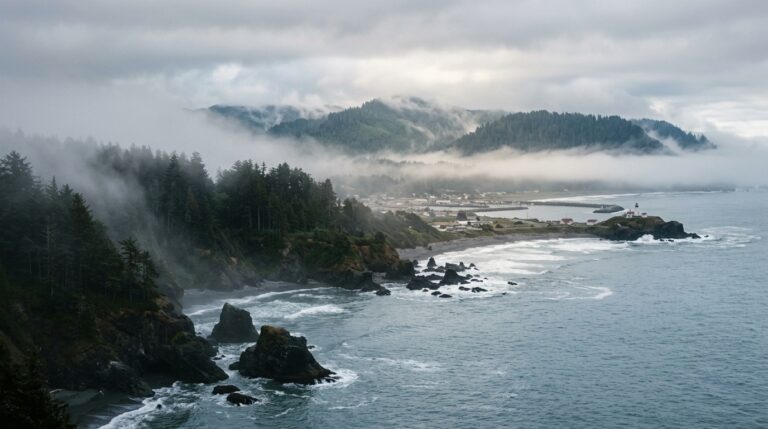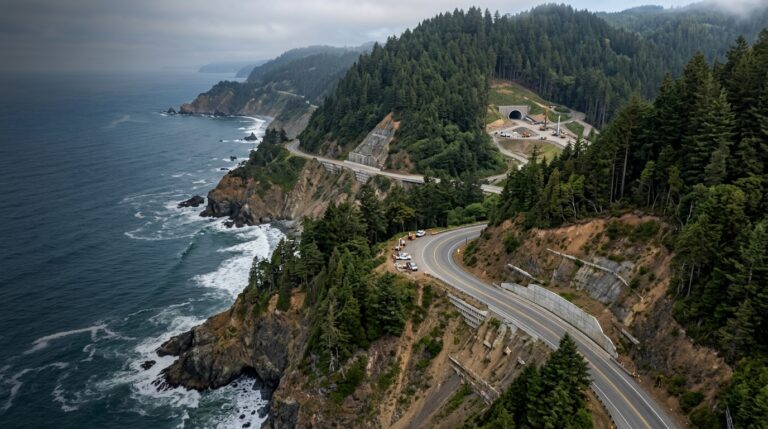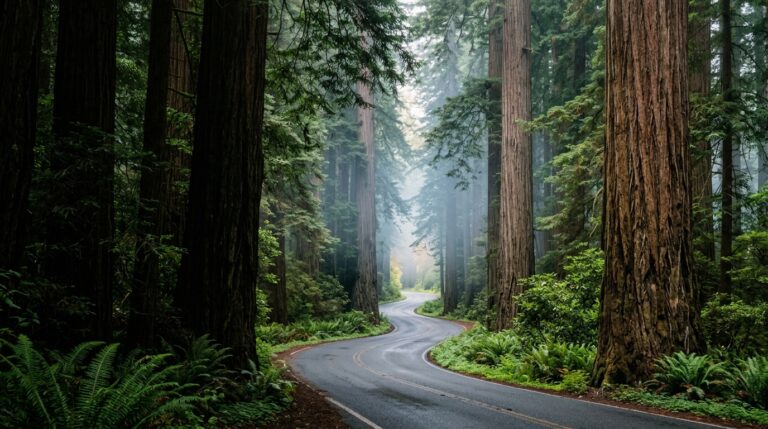
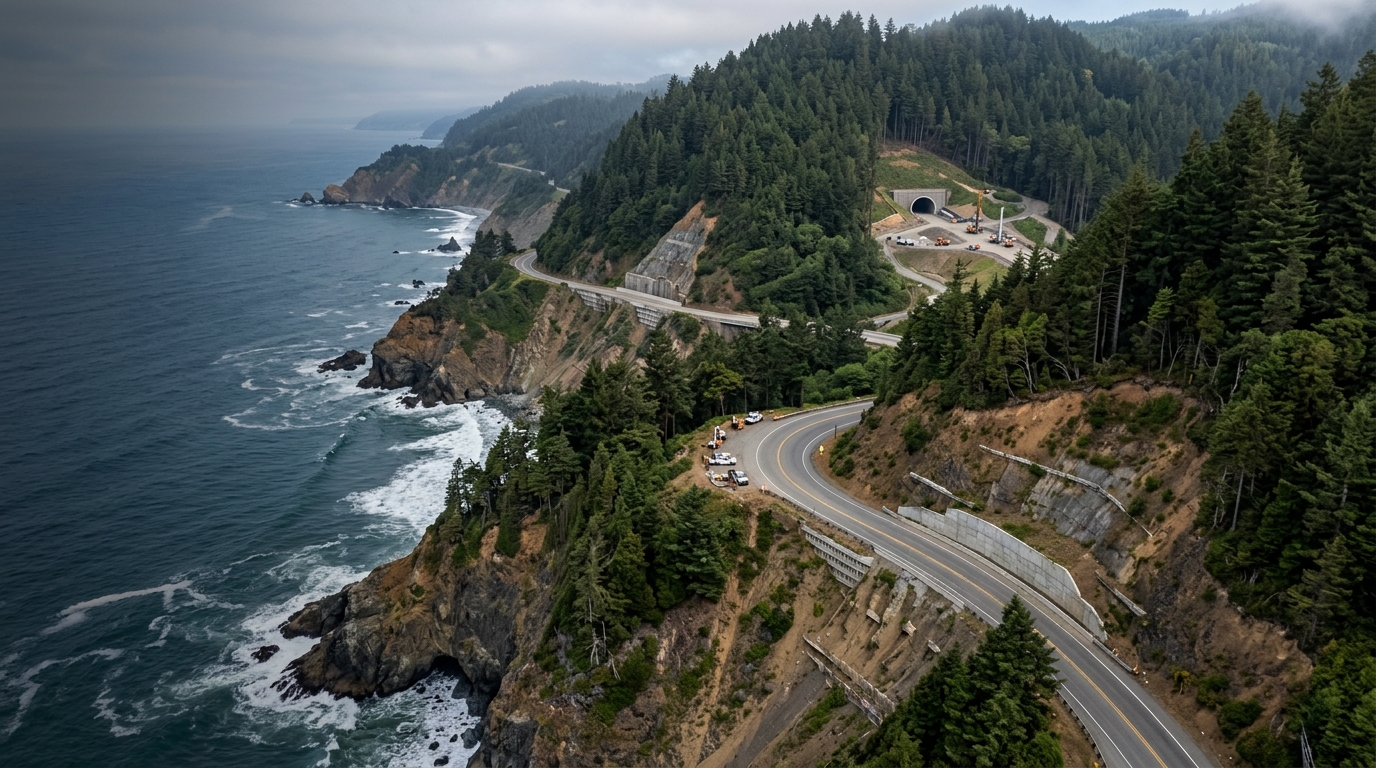
Last Chance Grade is one of the most important transportation stories in Del Norte County. This unstable stretch of U.S. Highway 101 sits between Klamath and Crescent City, where the highway crosses steep coastal terrain above the Pacific. Landslides and roadway movement have required decades of monitoring, emergency repairs, retaining structures, drainage work, and traffic management. For residents, freight operators, emergency services, and travelers, the route is more than a scenic drive—it is the county’s primary connection to communities farther south along California’s North Coast.
Caltrans has advanced a long-term plan centered on Alternative F, a proposed tunnel bypass designed to move U.S. 101 away from the most unstable landslide areas. The project has made meaningful progress, but it is not yet under construction. As of June 2026, the Final Environmental Document remained in quality-assurance review while design-consultant procurement, cultural-resource coordination, mitigation development, funding planning, and additional geotechnical work continued. Travelers can follow the official Last Chance Grade project website and use our Del Norte County seasonal updates for related road information.
Why Last Chance Grade Needs a Permanent Solution
Last Chance Grade covers roughly three miles of U.S. 101 north of Wilson Creek. The current highway is open and actively monitored, but the surrounding geology continues to move. Caltrans reports that more than $100 million has been invested in repairs and responses since 1997. Those efforts keep the road operating, yet they do not remove the underlying landslide and coastal-erosion risks.
A Highway Link With Few Practical Alternatives
A complete failure would create a serious regional transportation problem because there is no normal public detour around the slide area. The available back-road concept involves an old logging route with steep grades, four-wheel-drive requirements, long travel time, and seasonal limitations. It is not a substitute for a state highway carrying passenger vehicles, freight, school travel, medical trips, and emergency traffic.
Why a Long Closure Would Affect More Than Tourism
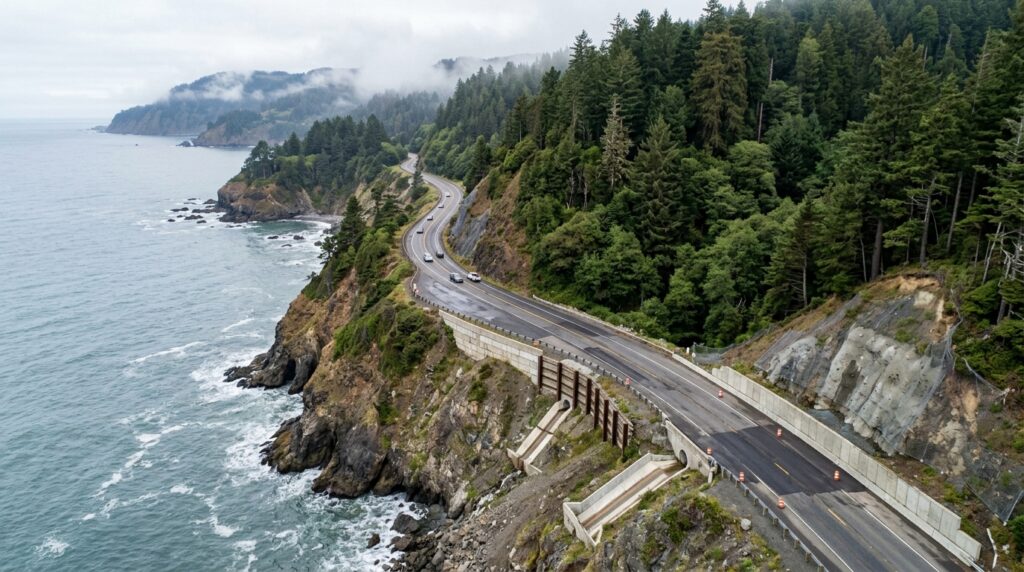
Visitors often think about Last Chance Grade in terms of reaching Crescent City, Redwood National and State Parks, or coastal viewpoints. The local consequences are broader. U.S. 101 supports access to health care, education, jobs, fuel, food distribution, construction materials, and other services. A major closure would separate Crescent City and northern Del Norte County from Klamath, Humboldt County, and the rest of California’s North Coast.
The route also affects travel confidence. Even when the road remains open, news about landslides can cause people to cancel trips or avoid the region. A reliable permanent alignment could reduce that uncertainty, although construction itself will require careful traffic planning. Travelers should continue checking real-time highway conditions rather than treating the tunnel as an immediate solution.
Why Maintaining the Existing Alignment Is Not the Preferred Long-Term Answer
Caltrans studied an option known as Alternative X that would have heavily re-engineered the existing corridor with larger structural and drainage improvements. Risk analysis found that the current-alignment concept still carried a high chance of some form of closure within a 50-year period. The full tunnel alternative was the only option assessed as having a low long-term closure risk.
Coastal erosion and increasingly severe weather add to the challenge. Walls and drainage systems can manage specific problems, but the landslide involves a large moving slope rather than one isolated failure point. That is why the selected direction focuses on bypassing the unstable area instead of relying indefinitely on repairs along the cliffside route.
What Caltrans Is Proposing
Alternative F would construct an approximately 6,000-foot tunnel and realign U.S. 101 around the chronic landslide zone. Caltrans has described it as a project that could become the longest tunnel built in the agency’s history. The concept is intended to improve long-term reliability while accounting for seismic safety, coastal change, sensitive habitat, cultural resources, and the operational needs of a major highway.
The Tunnel, Road Realignment, and Multimodal Access
The proposal is not simply a hole through a mountain. A functioning bypass requires tunnel portals, roadway approaches, drainage, ventilation and safety systems, emergency access features, earthwork, utility coordination, and connections back to U.S. 101. Current planning also includes substantial shoulders and a separated area intended to accommodate people walking or riding bicycles through the tunnel.
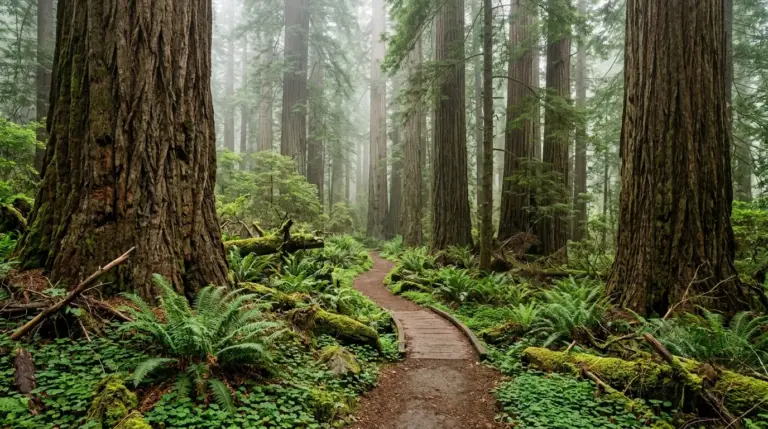
The surrounding environment makes every design decision more difficult. The project lies within the coastal zone and near Redwood National and State Parks, old-growth redwood habitat, wetlands, wildlife resources, ancestral lands, and culturally important places. Caltrans is working with tribal governments, park agencies, resource specialists, and other stakeholders to identify avoidance, minimization, and mitigation measures.
Cost, Funding, and the Difference Between a Plan and a Funded Build
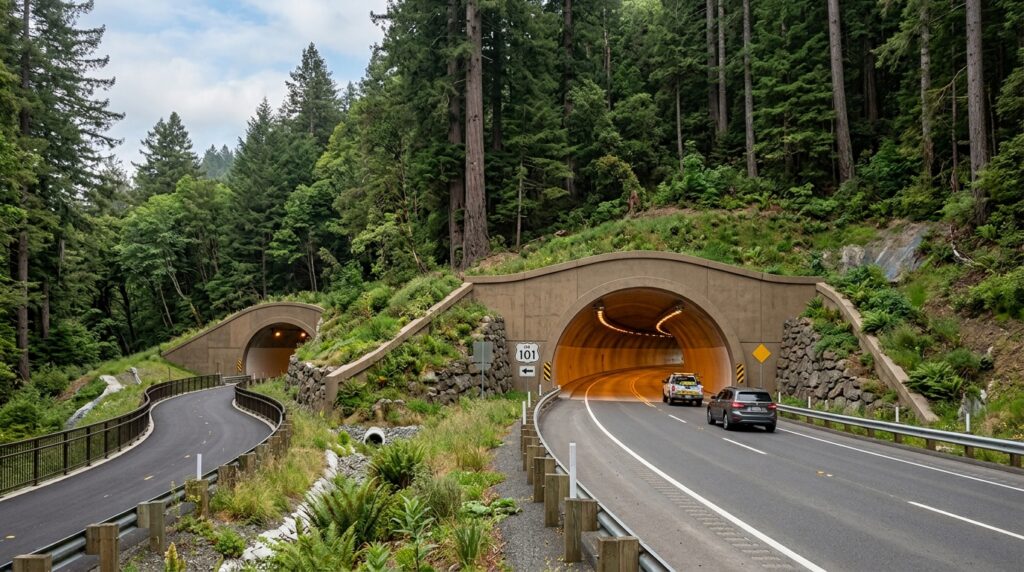
When Caltrans selected the tunnel alternative in 2024, it estimated construction at about $2.1 billion in 2031 dollars. That figure shows the scale of the project, but it should not be treated as a final contract price. Large tunnel projects change as investigations refine rock conditions, safety systems, disposal needs, environmental measures, labor assumptions, and material costs.
Funding is therefore one of the central questions. Environmental approval allows a project to advance, but design, right-of-way work, permitting, construction support, and construction capital must still be financed. The project team has been developing funding plans and procuring technical support while the environmental process continues. Delays or gaps in funding could move the schedule.
What the 2026 Project Status Means for Residents and Travelers
The most important point is that the permanent tunnel is still in development. The June 2026 update reported continuing quality-control work on the Final Environmental Document, ongoing procurement for final-design and independent technical-support consultants, continued mitigation planning, and coordination over cultural resources. Another phase of geotechnical exploration is planned from September 2026 through January 2027.
Timeline, Current Travel, and How to Follow the Project
The project’s published planning timeline places design and permitting between 2026 and 2031, followed by a potential construction period from 2031 through 2038 and public opening around 2039. These dates are planning targets, not guarantees. Environmental approvals, funding, geotechnical findings, permits, contracts, weather, and construction risks can all change them.
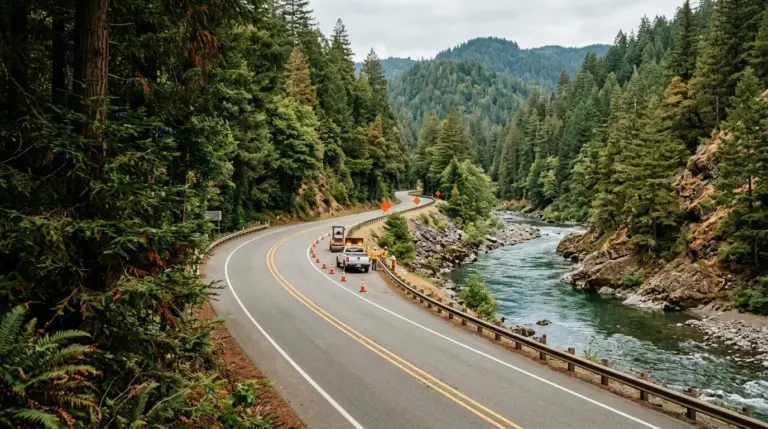
For present-day travel, Last Chance Grade remains part of the normal U.S. 101 route between Klamath and Crescent City. Caltrans says the highway is currently safe to use and monitors it for movement or damage. Drivers should obey reduced speeds, temporary signals, flaggers, and closure notices whenever repair or investigation work is active.
A practical travel plan should include extra time and a backup schedule. Before driving north from Humboldt County or south from Crescent City, check current highway information. Download directions before entering low-service areas, keep fuel above empty, and avoid scheduling a fixed tour or check-in immediately after a long coastal drive. Our Redwood parks summer 2026 guide explains how road delays can affect a wider itinerary.
Travelers arriving from Oregon should also understand that U.S. 199 is not a simple replacement for a U.S. 101 closure south of Crescent City. It leads northeast toward Grants Pass and may have its own construction controls. Review our U.S. 199 and Route 197 construction guide before using that corridor.
The project also deserves attention beyond traffic updates. It illustrates the difficult balance between transportation reliability and protection of a globally significant redwood landscape. A tunnel may reduce long-term exposure to landslides and coastal erosion, but its portals, access roads, excavation, material handling, and construction activity still require careful planning. Tribal consultation and cultural-resource agreements are not optional side issues; they are central parts of responsible project development.
Residents and businesses should watch for environmental-document releases, public meetings, funding decisions, design updates, field-investigation notices, and construction-management information. Travelers mainly need to distinguish between the future permanent project and current maintenance work. Seeing drilling, traffic control, or retaining-wall activity does not mean the tunnel itself has started.
For visitors, the wider lesson is to travel Del Norte County with flexibility. U.S. 101 connects major experiences including Klamath, Del Norte Coast Redwoods, Crescent City, and communities farther north. Use our Del Norte County travel guide to organize stops geographically instead of crossing Last Chance Grade repeatedly in one day.
The selection of Alternative F is a major milestone, but the Last Chance Grade tunnel remains a long-term infrastructure project. In 2026, the work is focused on environmental completion, technical investigation, consultation, procurement, design preparation, mitigation, and funding. The existing highway remains open under active monitoring, and travelers should rely on current official road information rather than future-project headlines. If approvals, financing, and construction proceed as planned, the tunnel could eventually provide Del Norte County with a more reliable connection to the rest of California’s North Coast.